PARENTING GUIDANCE
Start with what's happening.
Sometimes you know something isn't right, but you don't know what to do about it. Your child is worrying, getting angry, feeling overwhelmed or struggling with something you can't quite put your finger on.
You don't have to find the answer straight away. It can help to pause, understand what may be happening, and consider what might be useful next.
Start with the situation that feels closest to yours.
FIND YOUR SITUATION
What's happening with your child?
Choose the situation that feels closest to yours. You don't need to know exactly what's going on to begin.
My child is worrying
They're asking “what if?” questions, going over things again and again, or finding it difficult to settle their thoughts.
My child is getting angry
The reaction seems much bigger than the thing that started it, and you're trying to understand what's underneath it.
My child is overwhelmed
Everything feels like too much, and they're struggling to manage things that might normally feel manageable.
My child is finding it hard socially
They're struggling with friendships, feeling left out or having conflicts.
I'm not sure what's happening
You can't quite tell what's going on, but something feels different.
UNDERSTANDING THE MOMENT
Before you try to fix it, pause for a moment.
When your child is struggling, stepping in can feel like the most helpful thing to do. Sometimes it is. But children also need opportunities to experience difficult things, understand what is happening, make choices, face consequences, reflect and learn.
That doesn't mean leaving them to work things out alone. It means staying connected and present while providing the support, guidance and protection they need — without automatically taking over or removing every difficulty.
1. PAUSE
Notice what's happening before you react.
2. UNDERSTAND
Consider what might be happening for your child — and for you.
3. CONSIDER
Explore different possibilities and perspectives.
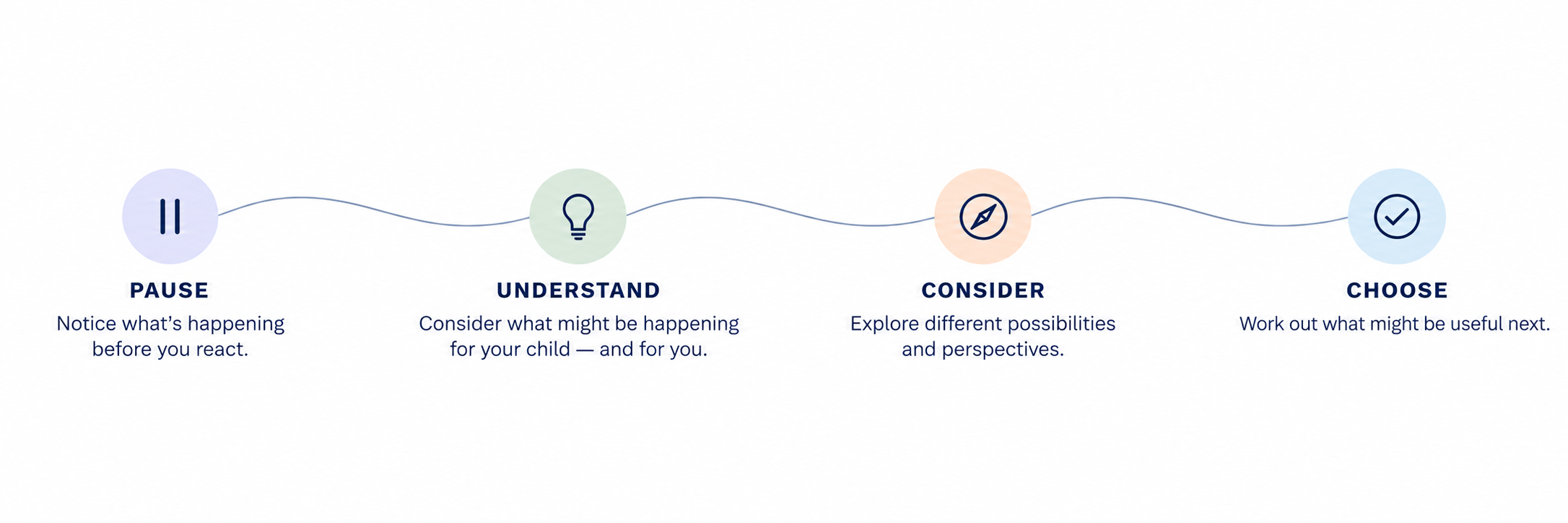
4. CHOOSE
Work out what might be useful next.
Connection doesn't mean taking over.
“I'll help you.”
“Let's work it out together.”
“What do you think?”
“What could you do?”
“You can work this out.”
PRACTICAL GUIDANCE
Understanding what might be happening
Sometimes it helps to look beyond the behaviour you can see and consider what your child might be experiencing. Understanding doesn't give you every answer, but it can help you work out what might be useful next.
Understanding Anxiety & Worry in Children
Explore what worry and anxiety can look like, how they may affect children, and what might help you understand your child's experience.
You don't have to work everything out at once.
Start with the situation you're facing. Take time to understand what might be happening, and explore what could be useful next.